
Five GCSEs at grade 9–4, including a grade 4 or above in English, Maths and a creative subject – or portfolio. BTEC Level 2 qualifications considered in subject related courses.
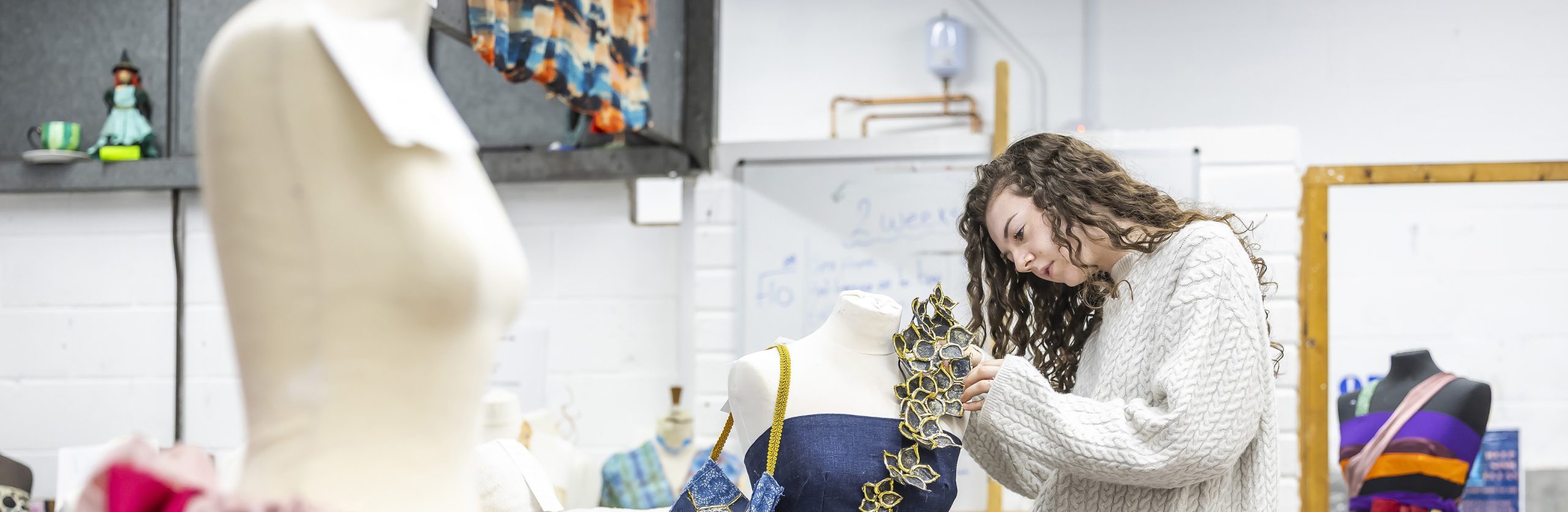
You will develop skills in a broad range of textile, fashion and craft based processes and technologies within a functional or decorative context. The emphasis is on surface pattern and you will apply this work to different products. Within a purpose built studio and explore printing and image transfer, stitch, weave, off drape garment making, ceramics for accessories and interior products
Five GCSEs at grade 9–4, including a grade 4 or above in English, Maths and a creative subject – or portfolio. BTEC Level 2 qualifications considered in subject related courses.
First Year
The first year is about exploring different types of textile design and development. It introduces you to a wide range of possibilities, that will develop the skills needed to choose a preferential area of study in the second year. We focus on surface pattern, drawing, mark-making fabric manipulation and image transfer as well as construction skills and drape garment construction. We also introduce you to the darkroom and ceramics for accessories.
It is vital that we explore the work of others work, cultural, historical and contemporary design and sustainability will be studied and written about. The first year is assessed both formatively throughout the year and at the end of the year as a portfolio submission.
Second Year
Personal Investigation – this is an in-depth critical, practical and theoretical investigative project based on themes and subject matter that have personal significance. It is supported by a written element of not less than 1000 words to underpin the practical project.
Externally Set Assignment – using a series of visual and written stimuli presented by the exam board, you will provide a personal response in terms of a practical project within a 15 hour period of time supported by preparatory work
Component 1 – Personal Investigation (worth 60% of A Level)
Internally assessed, externally moderated.
Component 2 – Externally Set Assignment
(worth 40% of A Level)
15 hours of sustained focus work. Internally assessed, externally moderated
Fashion and textile design can lead to a career path in menswear and women’s wear, textile surface pattern, costume design and fashion marketing. Illustration, accessories and shoe design as well as Interior decoration.
You may also wish to progress on to a pre-degree Foundation Diploma in Art and Design offered at Andover College, rated Outstanding by Ofsted.
Many students have gone on to be successful at a variety of the Top art universities.
A studio fee and kit list is set in August of each year for each course. They can be purchased from the College via the online College shop. There may be print costs throughout the year depending on projects. The College has support funds available for those students who have difficulty meeting the costs.
There will be the opportunity for a variety of trips and visits on a rolling programme that include: The London Design Circuit: Regular visits to the V&A Museum, the Fashion and Textile Museum, and contemporary galleries to see historical haute couture and avant-garde installations in person. As well as trips to Bath and Bristol.
Dedicated spaces for working with fabric including dye, image transfer, sewing machines. Printmaking facilities and dark room access. laser cutter and kiln for accessory making.